PLU Gazette - Summer Edition 2026
Editor’s Note
We are delighted to bring you the third edition of the PLU Gazette (The PLUG,) edited by Quitterie Gounot, Raija K. Heikkilä, and guest editor Sue Burge. The theme of the current issue, THE MOON, was inspired by a PLU writing workshop session hosted by Sue in Paris. On the day of the Lunar New Year, we posed Sue’s challenge to a broader public: To write or create art about the Moon, an ever-popular subject of inspiration, without falling into clichés. And rise to the challenge you did! (For our part, we gave the Moon its chance to shine in a summer issue, at a time when the collective focus is generally on the Sun.) Our editorial trio was thrilled by the incredible response to our call for submissions and extends our heartfelt thanks to all those who shared their artistry and passion with us. This outpouring of creativity reminded us of the Moon’s wise lessons; for one, we too change in phases like the Moon, and we too can start anew.
Just this April, as we pored over the 150-plus pieces received, four intrepid astronauts on the Artemis II mission orbited the Moon. Today, we invite you to join our own poetic expedition, launched from our organization’s open mic stage in Paris with readings by some of the local contributors and featured submitters to the issue. Through their unique, original takes on the Earth’s companion, the thirty pieces selected for publication transport us back to childhood wonder, remind us of the magic of myth, guide us through the joys and pains of love and adulthood, and demonstrate the power of ritual in transformation. On our way to the Moon, we travel across our equally fascinating planet, from Parisian streets filled with nostalgia to the storied English countryside of the “Moonrakers” and perilous Amazonian waters. Just grab an ever appropriately shaped French croissant (or the next best thing where you are,) and dare to dream and journey with us from the comfort of your own home.
Table of Contents:
Part I
On Borrowed Tea Time by Christine Nguyen
You, moon by Sue Burge
Moon Dance by David Keyworth
moon must by Paul Stephenson
Ask a three year old by Mark McDonnell
Mater Luna by Kelly Pham
Part II
No 17 - October 7, 2025 (from the ongoing series: Moongrams) by Nechama Winston
Lupa Mulier by Amanda Michaela
Blooming Beside a Kindred Moon by Ana Flavia Lessa
The Moon Collector by Sambhu Ramachandran
Moonraking by Eira Twire
False Moon by Jean Hall
Part III
Moonstruck by Sarah James/Leavesley
My Dear Beloved by Sarah James/Leavesley
Giving the Moon to the Muse by Paul Hostovsky
i would give you the moon by Christian Hanz Lozada
Love at 25, Session 7 by Michael Alcée
Busted by the Moon by Glen Vecchione
Part IV
Luteal Lament by Christine Nguyen
Mammogram by Christina Lloyd
The Biggest Piece of Cake by Charisse Gendron
Luna by Bina Emanvel
Moon Phase by Gerard Sarnat
Perpetual Miss Insomnia Pageant (Some Recurring Phases of the Mind) by Liz Duff Young
Part V
No 44 - March 8, 2026 (from the ongoing series: Moongrams) by Nechama Winston
me, the medium, the message by debanjana
Paris Moon by Cristina Bejan
Chassez la lune, elle revient au galop by Emily Monaco
A Starling Dance, For the Moon by Grace Kilborne
PhD Defence by Jon Baird
If reading on a phone, we recommend holding it horizontally to avoid distortion to the form of some poetry pieces.
Part I
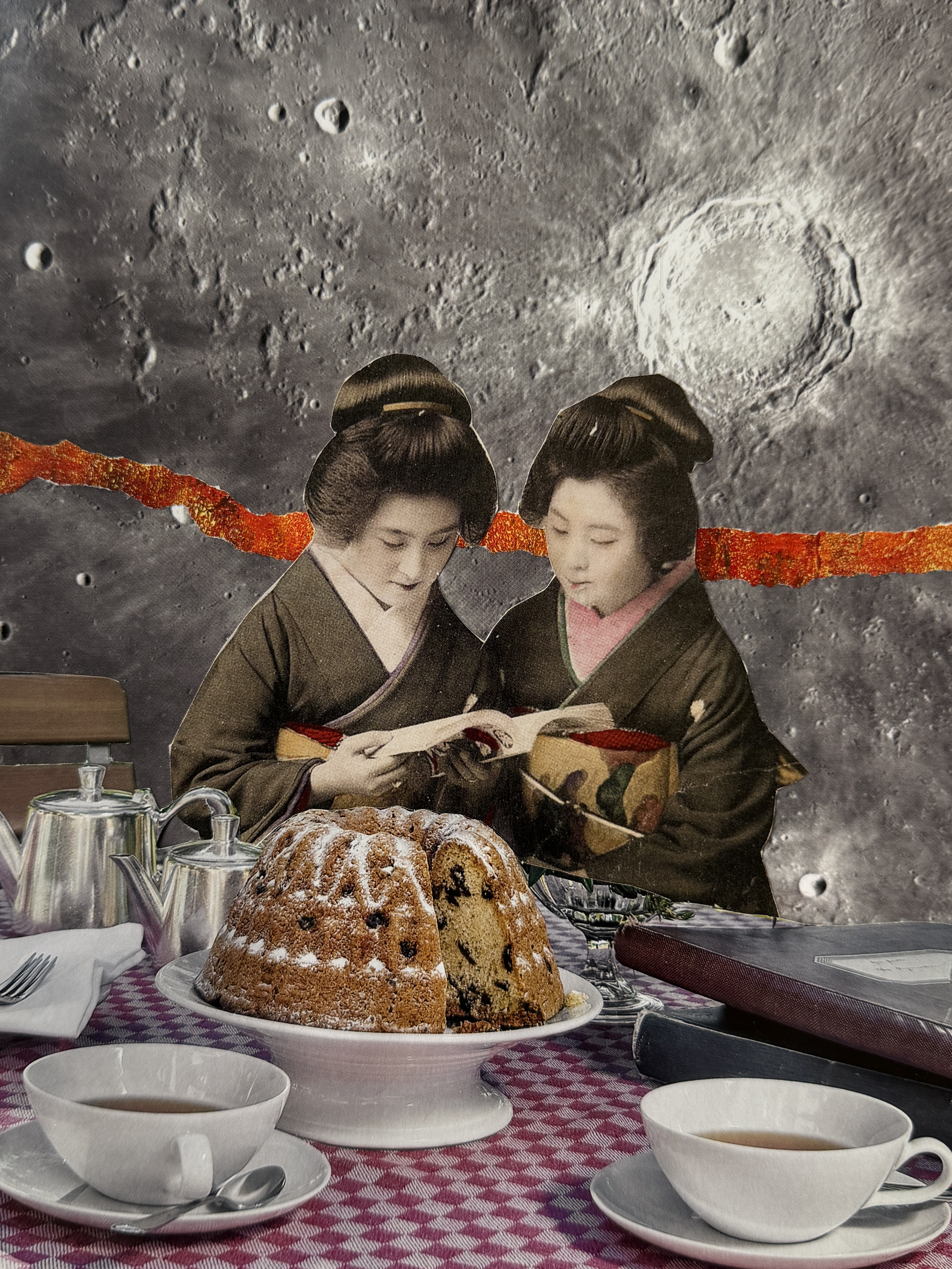
On Borrowed Tea Time by Christine Nguyen (collage)
You, moon
by Sue Burge
stalking me again
jaundiced hide-and-seeker
behind a conspiracy of pines.
You found me, moon, when I was a hapless baby,
blanketing me in pale unbidden light.
Do you keep a file on me, hidden in the stars?
What do you want? I am so small,
and you, moon, so big and famous:
perhaps you are tired of all the sequins and tiaras.
You, moon, just-out-of-reach pill from a forbidden bottle
shiny, saffron macaron ripe for biting
psycho-geographic cipher decoded by spires.
I was a shy diva, under your disco ball ꟷ
you would unspool me, moon,
like a film in reverse
menses falling and falling like gravity.
Some nights I watch moths
adjusting their flight-paths to reach your craggy lips.
Oh moon, moon what do you do with all that swallowed daylight?
Sometimes I forget you, moon,
but it is hard when the world is full
of round things and their diminishments:
here you are, at the bottom of my cup,
tea-leaves your mysterious seas.
You silver my wrinkles as I sleep, moon:
your bright face will be my penny for the ferryman.
My little suitcase is always packed.
Moon Dance
by David Keyworth
Owlet Moth orbits orbits orbits
around a guttering filament
in a long-abandoned nightclub
and circles a mirrorball
on the derelict dance floor
in ecstasy
because it has found its moon.
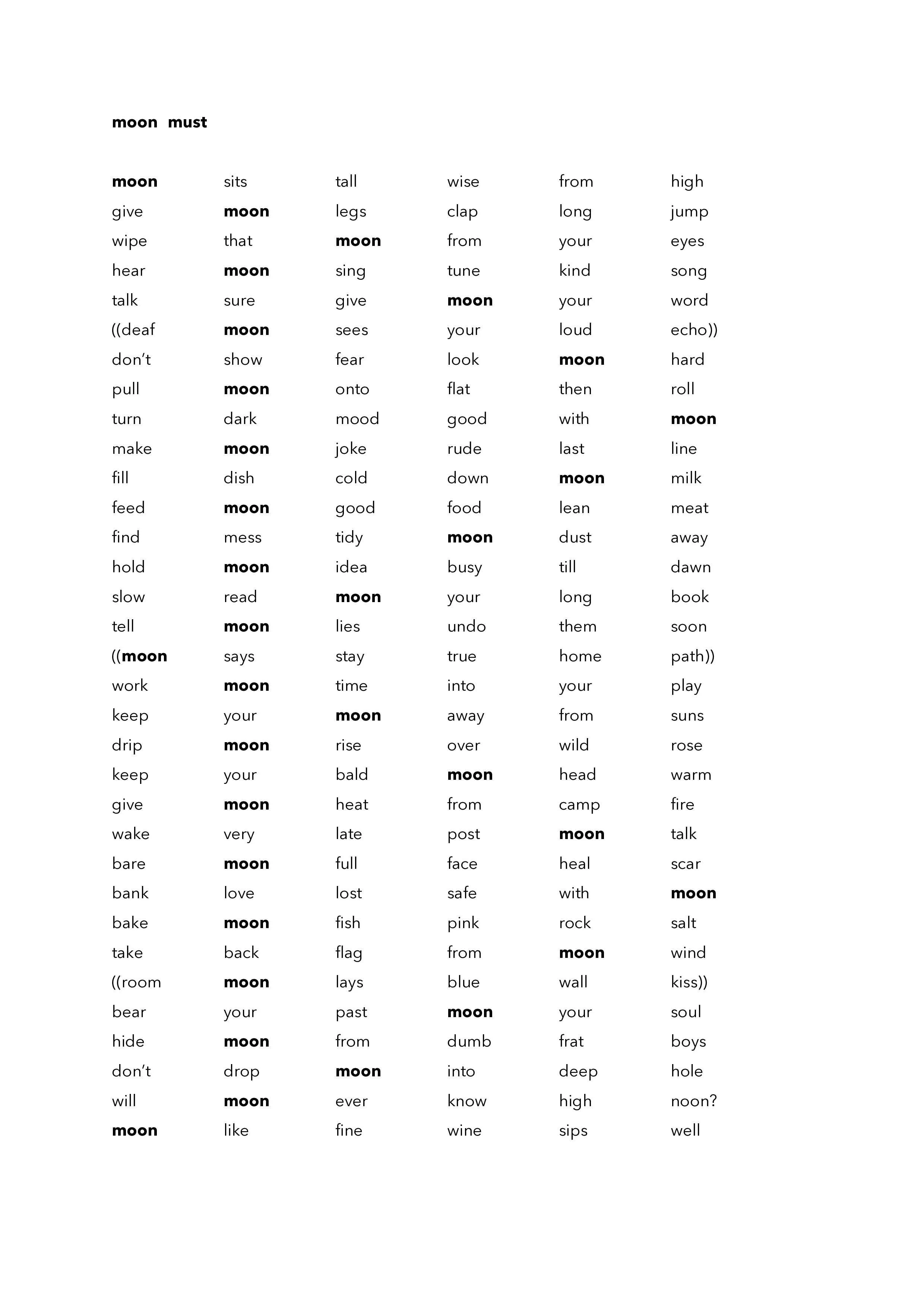
moon must by Paul Stephenson (visual poem)
Ask a three year old
by Mark McDonnell
The soft fruit of his face
next to my bristles
between car and house
The night cold and clear
The stars, he tells me,
are crackling — crackle, crackle
And the the moon? I ask
What does it sound like?
A trumpet — it’s blowing a big squeak
right in my eyes
Mater Luna
by Kelly Pham
The other day I was playing twenty questions with my children and they were not able to guess what “it” was and asked for a clue. I thought about this for a moment and said:
“It’s always there but you never really think about it.”
My kids took this in and my son blurted out, “Mom!”
I couldn’t help but smile, proud that to him, I was always there. But then again, he never really thinks about me?
My thoughts were interrupted as he eagerly demanded to know if he was right.
I hesitated. He wasn’t exactly wrong but it’s not what I initially had in mind. Both did start with M. Then O.
I told him that it was a good guess. The answer?
The moon.
Recently I’ve been thinking about my own mother. Ever since I’ve been around, she’s been around. And like the moon, even when she’s out of my thoughts she’s there, an integral part of everyday life. A presence so massive it has its own gravitational pull.
I read an article once about how the moon is actually slowly drifting away from earth. My mom is turning eighty this year and her memory is fading. I feel she is also drifting away.
What would happen if one day the moon was no longer there? A disaster for sure. Everything would be amuck. Best not to think about it.
Part II

No 17 - October 7, 2025, from the ongoing series: Moongrams by Nechama Winston (silver gelatin paper exposed to moonlight, Unique, 10h x 8w in.)
Lupa Mulier
by Amanda Michaela
I do not mean, I tell him, earnest as a palm
leather-pressed, to feel like this. I say this
while gulping down a cauldron of fists.
Even now, a dog-eared creature yelps to be
set free of my ribs, the stifled cage gnawed
and unbidden. One look from him and it will
hound my throat with a piteous note. I offer
a clatter of bones strictly wrapped, but it is
unsatisfied with clandestine harm. Seeks
the bruised loin, irremediable gash
blood to prove the wound wrought by mere
existence. He adorns my hair with lavender
and apples, reproaches my untimely sadness
but I am not dazzled by the option
of lassitude. My whole body begs
to be used, to be crushed to life and love
the arrow’s gasp before it splits the fruit
in two. I do not intend any violence, but it
inhabits my nerves like a wolf treads through
her village. Blanket to chin, I shirk in madness
until consumed. He prefers me undevoured
but this whorish viscera creeps down
so many terrible throats. Apostle of electric
grids, the dog-eared creature seethes
for the shock, then nurses its wound
like a child unloosed from the teat. All roads
lead to this : a grief so large its foundling
love howls through the stars
and begs to give them a name.
Blooming Beside a Kindred Moon
by Anna Flavia Lessa
“Don't you dare dive into waters you don’t know,” my mother warns me, religiously, every time I’m about to leave for one of my adventure-filled trips.
As a child, my mother, Luzia, lived in a hot, inland town in the state of Paraná, Brazil, where she was fortunate to have an idyllic river run close to her house. She grew up hearing the same warning over and over from her own parents: Be careful; that river is treacherous.
One blazing afternoon, she went to bathe in the river with her younger sister, Silvia, as usual. But that day, the currents were especially strong, carrying heavy traces of the torrential rain that had fallen the night before. She advised her sister to stay close to the banks, yet despite her warnings, my aunt’s fragile body was swept away by the pull. Desperate, my mother threw herself into the water, watching her sister’s small head struggle to stay above the surface. When she finally reached it, she had no strength left to hold the weight of both bodies while fighting the current. They were dragged several meters downstream until a mulberry tree offered them a hand: Its thin branches stretching beneath the river’s skin allowed my mother to cling to it, anchoring them back to safety.
Nearly fifty years later, my mother holds on to the belief that waters are always treacherous as tightly as she once held on to those branches. And that old fear of external currents reflects those currents within her. Though strong, practical and rational, she carries within her an ocean she refuses to swim in. Irrepressible waves she keeps tightly contained because she has never felt safe enough to let them move, even as they quietly continue to steer her days.
Much to her despair, ever since childhood I’ve always felt entirely safe — complete even — whenever submerged. Perhaps it’s because some ancient part of me remembers the quiet cradle of her womb, suspended in amniotic waters. Or perhaps it’s something older still, a memory older than my own life, older than humanity, the body that is 70% water recognising its own element, the very substance that shaped the first stirrings of life on this planet.
My mother used to tell me indigenous tales that arose out of water, perhaps hoping to plant a little fear in me. But my little eyes just widened with curiosity as I listened to her voice: “Naiá, a young indigenous girl, longed for Jaci, the Moon goddess, and dreamed of becoming a star. One night, she leaned over the river, drawn in by the Moon’s reflection, and reached toward the shimmering light. To grasp the reflection, she fell in and drowned. Moved by her devotion, Jaci transformed her into the giant Amazonian waterlily, Victoria Regia, the floating star ”
As a child, I would always ask her to tell the story from the water’s point of view, eager to dive in rather than just listen from the shore. Only now do I realize that every telling already belongs to the water. Our own eyes are mostly made of it, so we never quite look at water: we look through it. The viewpoint I thought was out there, in truth, came from within. The story went: “I was dancing and speaking with the Moon when she appeared: a girl with eyes full of longing, believing my surface was a boundary she could bend. I was stunned by her audacity in underestimating my depth. She leaned closer. Too close. When she fell into me, I entered every channel of her being, felt her pulse dissolving into mine. Then, the Moon intervened; Jaci sent a narrow beam of light plunging into my darkness, and the girl unraveled into a seed. It burst like a quiet firework, rising and tickling through my body until it reached my surface, where it opened into a luminous star, floating beside her kindred Moon.”
Last week, I finally convinced my mother to join me in the sea for the first time. Still hanging close to the shore, she let the waves pull her a little farther, meeting the vast, unmapped waters within herself. Gently yielding, cautiously opening: like Naiá, blooming beside her kindred Moon.
The Moon Collector
by Sambhu Ramachandran
Under the old woman’s bedstead
sat an antiquated wooden chest
with intricate inlays of curling vines
and trefoil leaves. In it, she kept
the carcasses of all the bloated moons
she had dredged from the gelid depths
of her backyard pond flecked
with white papaya blooms.
There were all kinds of suicidal moons
that had dodged white-uniformed clouds
and lunged pliantly through foliage
to a silent underwater death
in her spacious chest—
full, gibbous, and crescent.
Flattened by the headlong splash,
they had become two-dimensional
and timid shadows of their onetime rotundness,
but embalmed in fancy’s unguents,
they still held on to their pearlescent flush.
When they found the old woman drowned
in the hyacinth-hemmed shallows of the pond,
her white head was seen to shimmer moon-like
under the water’s dark green skin.
Those who ransacked her hut
found a cobwebbed chest,
out of which tumbled smooth flat pebbles
mottled with the subtlest grey and amber.
They might have cursed her crankiness
before emptying its contents out.
Only the windows began to glow at midnight,
and it was like a cool cosmic fire had made them so.
Moonraking
by Eira Twire
My Dad once told me about the smugglers who were raking for brandy barrels stowed in a pond. When they were found by the Excisemen, riding in from the Town, they said: “We be a-raking vur tha gurt cheese.”
The Excisemen saw before them two fools combing away at the moon’s shuddering reflection. They laughed and rode off. In Edward Slow’s telling, the fool was the one laughing at these Wiltshire clowns.
And so, we of Wiltshire are called Moonrakers. But Outsiders like to forget the smuggling part in their tales.
***
Years later, I find myself studying the moonrakers in Paris. My colleagues study normal books and break spines. I am raking away, searching for a spineless literature. The stories I like speak between their fragments. I’m back to an old obsession, reading and collecting postcards.
There is a Moonraker postcard entitled ‘Rake, Daddy, Rake.’ In 1911, Gwendaline lists her itinerary of trains to Weston-super-Mare. I wonder why she chose this card, of all frames. Why did anyone of those: The Safe Arrivals. The Many Happy Returns. The Long Promised Sent At Last. The Jolly Times in Bristol. The Mundane of the Mundane.
I wonder if many of them were Moonrakers too. If these were little messages reminiscent of a lost Home. Families, friends, now distances apart thanks to the railways.
***
I have found another postcard from 1910. Swindon supporters from nearby Purton dressed in rustic hats and bearing rakes. Again, in the 90s, Swindon Town FC made it to the Premier League. Our mascot was only a man. He dressed in a brown tunic and lifted his rake high.
It’s strange, this identity. The legend takes place somewhere near Bishop Cannings. So far away from Swindon. And with this said, until the arrival of the railway factory in 1840, we were only a pig-rearing village on a hill. Sixty years later, the biggest town in the county. Scots, Welsh, strangers from all over the Isles and Wiltshire came to work here. Did they adopt this tale and why ever so? Or was it the remnants of those former country rustics keeping it alive?
***
The Wiltshire Regiment were also nicknamed the Moonrakers. There’s a First World War cigarette card of a soldier raking the moon in the sky upon the Salisbury Plain. On the horizon, there is the silhouette of Stonehenge.
Reminds me of a Canadian article from 1914. An officer at the Battle of Mons rallied, “Come on, men, we are Moonrakers!” This cry spirited them toward the chuckling of German bullets. Dead.
The railways changed our life, but also buried many of us far away.
***
Alfred Williams, the Hammerman Poet, used to look out from Swindon’s Railway Works to the flat-topped castellum of Liddington Hill, like a ghost in the smog. The forge was slowly murdering his digestive system. For him as well as the naturalist writer Richard Jefferies, Liddington was an older time, a place of health.
I think of this hill’s lure. It’s unremarkable to outsiders. But it looms over us. My granny’s hospital room looked straight at it. She rambled nonsense about two boys on it “having such fun. Look, this one has his hat over his face.” Historians argue that here King Arthur fought the Battle of Badon. And for me, I used to tell my Dad the tree clump on top was a dinosaur grazing.
***
“You don’t have your father's accent,” said my Dad’s Old Friend. They moved away to France many years ago.
When I was younger, other kids would call me a Tory or posh for the way I spoke. I didn’t want to sound stupid. But also because my granny was teaching English before in Karachi, I couldn’t speak Wiltshire with my Anglo-Indian grandparents. I had to speak proper.
Since Paris, I feel it seep through. No one understands when I say ‘tuth’ for a tooth; or ‘Rth’ instead of Earth.
***
In my first year in Paris, my girlfriend was hospitalised. We had just got together. People looked to me for answers, but I knew no more than them. I felt very alone and confused. I couldn’t bear going back to my flat.
One night was bone clear by the Seine. And there was the Moon, a friend.
***
In the National Gallery of Dublin, I found a painting with a pin-dot moon, shining through the clouds like a stark eye of a heron. O’Connor’s painting ‘The Poachers’ was incredibly similar to a Moonrakers postcard, printed some 100 years later. Same Moon. Same dark figures dwarfed by the landscape around them. Same battle.
Someone somewhere and much Greater Than Us was stealing something: these poachers were fighting the nobles who had appropriated their common lands; our moonrakers against the exciseman and ridicule from the Town.
***
We have an unofficial anthem in dialect. I laugh at it because it’s shamelessly rural and adorable. Maybe I also laugh because I anticipate the judgement of others? But what is wrong with happiness in turnip hoeing?
As is tradition, the newly elected MP of Salisbury sings this from a balcony. The crowd declares their love, an unwandering eye, from keeping the turnips clean of flies.
But what is the draw of this song? Is it a glimmer of moonraking—a comfort in one’s own skin? I think. Mockery doesn’t bother a Moonraker because, while the vlies are on the turmuts, there is none on we.
But even so, I’m still confused by my-self, by the slaughtered officer at Mons, by the postcard senders, and Edward Slow’s Moonraker poetry. Those who frame themselves and their everyday with this Silly Little Tale from the 1600s.
The gaps between these fragments speak so loudly to me.
There is something I feel. Industrial life forcing its way on our bodies. Slow’s fear of our dialect’s extinction. People dragged to die far away from here. It seems something draws them to moonraking. Even if there really are no hoers left.
Nor rakers.
False Moon
by Jean Hall
even non-believers whisper reverence
departed souls who feared and wished
for death acceptance in footprints
filled in by driven snow
forty below cold took them gently
in their sleep browsing through remains
of their youth their inherited dispositions
with calm and dedication
they had seen tabular icebergs
larger than cities tilting cracking
lofty mountains countless peaks
newly chiselled marble shadows
sixty shooting stars a minute diamond
dust rime crystals in the polar vortex
iridescent colours breaking through hard
white landscape formless blue
ripples in the red textures coloured
like mother-of-pearl the visual spectrum
of blues and greens in the ice and snow
ice-filled bays at the foot of glaciers
they’d venerated the luminous ring
around the full moon captured on canvas
the bright circular spot near the moon’s halo
the paraselene moon dog the false moon
it was the last one they saw
Inspired by Edward Wilson’s painting Paraselene, June 15th 1911 on Captain Scott’s Terra Nova Expedition
Part III
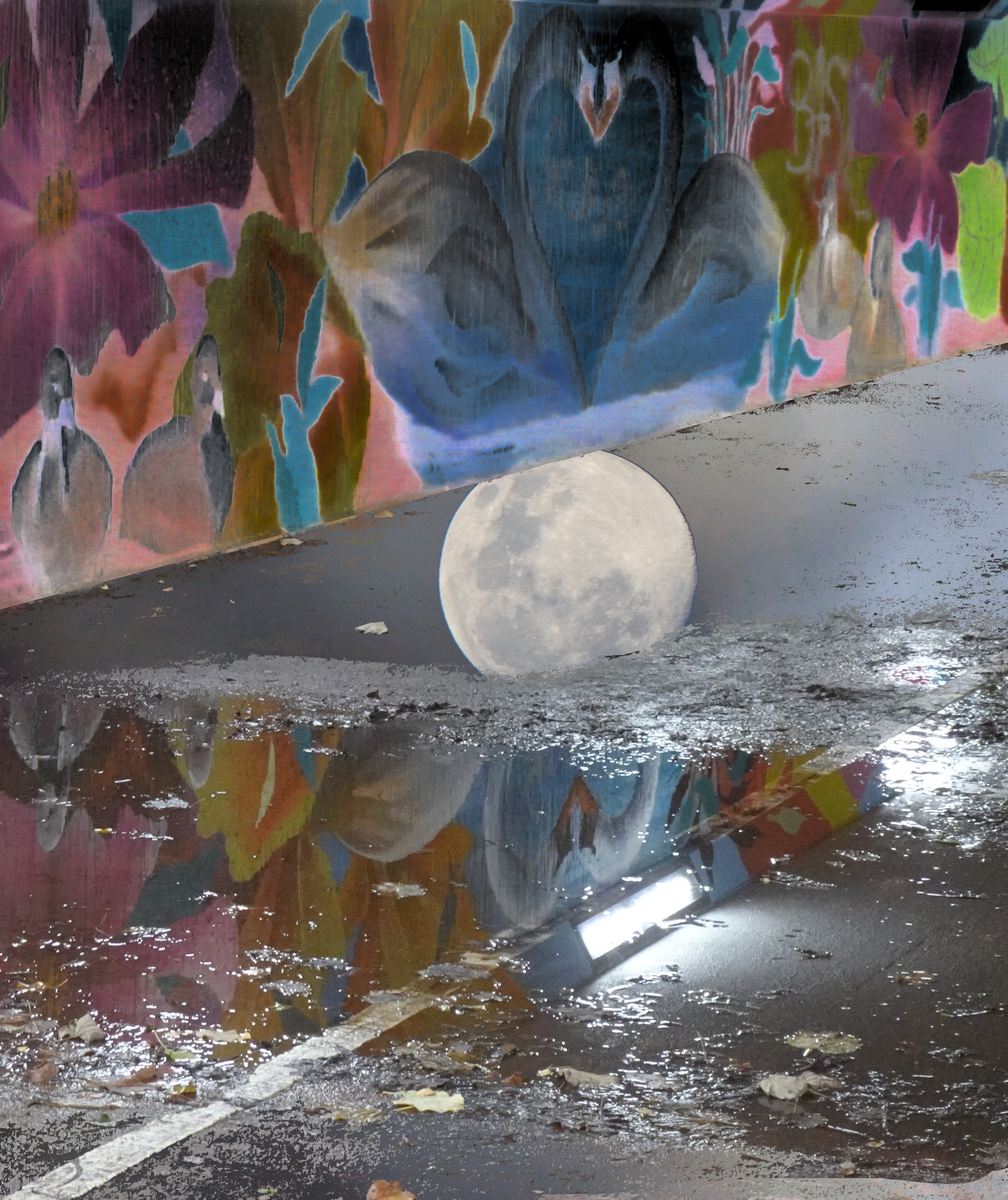
Moonstruck by Sarah James/Leavesley (photograph)
My Dear Beloved
by Sarah James/Leavesley
This isn’t the world you once knew but I write
by the only real light left: your eons-old
white glow wax-candling the night and acres
of concrete fields spread out far below.
Lots may have changed but I haven’t forgotten
what it is to love and worship greenly.
With Saturn’s blue ring, I would thee wed –
you, ma chérie, the one true moon, sliding in
through closed shutters, straight to my bed
Whisper a soft yes in my ear, let it pulse
towards me, pushing back the tides’
encroaching waves of global warming.
We might not have much time, but enough
for a brief honeymoon, if I could find
a safe place away from littered streets.
One last unflooded island. If I do, say you will
forget past trespasses, forgive the daily greed,
and stay bright a little longer, shining
quietly on the nature we all need, gifting
respite from artificial suns, lifting weight
from tired eyes, reminding our remaining trees
of how it was to still be blessed with birdsong
nesting and blossoming in their leaves.
I hear the barn owl call to you with a voice
that recognises its own kind, the kind of voice
humans lost before my birth – except
in the heart’s depths. A ghost of this
cries out now as you dim, leaving regrets
on my pillow, and cast-off feathers drifting
further and further from my dreams.
Giving the Moon to the Muse
by Paul Hostovsky
Come away with me, he wouldn’t know
a good line if he wrote one.
Look at that pared fingernail moon
out over the water.
I love your voice more than anything, more
than the truth and that’s the truth.
Look at that opening parenthesis
of a moon out over the water.
I have no money but I have a great nose.
I have tickets to Sappho and the Bits.
Let’s get a bite to eat with our hands.
Look at that bitten-off moon out over the water
Let’s walk along the boardwalk and feel the grit
of great ideas underfoot.
Let’s listen to the gulls complaining
they have no hands though they have
the history of a great idea
for opening the clams–
dropping them from two stories up.
Look at that broken-open moon
out over the water. I’m a stenographer in the precincts
of sleep after lovemaking and I have
free passes. And I have
an enormous bladder. And I’ll have
whatever you’re having. Look at that fortune cookie moon
out over the water. Let’s get some air, let’s get some earth,
fire, seawater. Give me your mouth and I’ll give you
my thumbs. I’ll give you that thumbnail moon
if you’ll just spit in my hand.
i would give you the moon
by Christian Hanz Lozada
i would lasso the moon
is a lie to say i will go just
beyond what my body can
i would lasso the moon
is a lie to say i will use
my endurance on the foolish
i would lasso the moon:
a promise to lighten your night
and darken everyone else’s
a night person like you
uses the moon more than me
so i can promise to lose it
if it created more afternoons
when we feel safe enough
to throw our bodies at each other
and shrink the daylight
all edenic and bright
like the morning after shame
Love at 25, Session 7
by Michael Alcée
After Tracy K. Smith
My patient
he wanted it
to be that way,
wanted to take her
out of his history, out of
his sights, his bones,
the beating of his errant heart,
how had he been
so taken, so tethered, so tickled,
tremulously off balance,
out of this world?
But that’s just the physics
of love, I offered, in that force-
field beyond right and wrong.
Love begins as escape
velocity, a vessel for us
to see earthrise, to spy
geography:
who we take for granted
while searching for another.
Alone, now with our own dark matter
we are free but how
to return, how to embrace
who we were before,
now out of reach?
Busted by the Moon
by Glen Vecchione
I’ve never been taken by the moon
the color of the Mare Tranquillitatis
reminds me of a baseball field in Nebraska
moon:
unwelcome beacon through the windshield
after you’ve parked with a date and unzipped
spotlights your sorry self as you sit on the lip
of your flatbed swilling sacked hooch
confounds with reflections the rescue
of a phone knocked into the lake by an oar
god-damned moon asshole of light
pearl in the navel of a blue-bellied pasha
the moon never helped me fall in love
but it taught me to swear.
Part IV
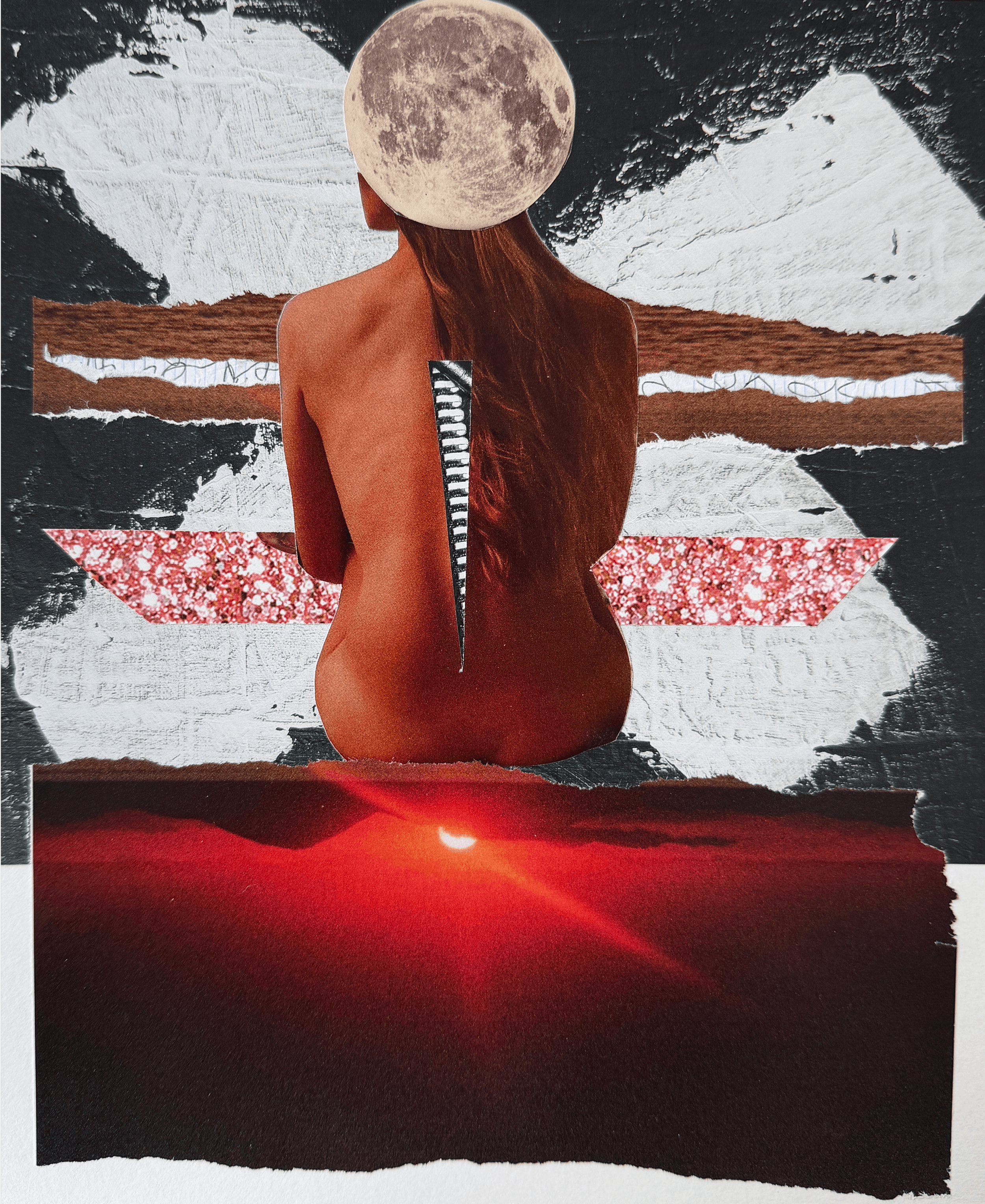
Luteal Lament by Christine Nguyen (collage)
Mammogram
by Christina Lloyd
The technologist wheedles me into bizarre poses.
She adjusts the rollers to compress my breast
between plastic plates, tells me to turn my head
as I grip the curve of Senographe Pristina, the machine
whirring and clicking in a circular motion as I stay still,
mutely pairing its name with mine: Pristina, Christina.
Afterwards we wait for the radiologist to read the signs.
She is faceless, somewhere else. I sit in a pink gown
in a dimly lit room. An x-ray of my breast a glowing moon.
The Biggest Piece of Cake
by Charisse Gendron
A jet plane flies over a bitten moon,
depositing a tapeworm in the night sky.
We are so hungry we eat planets.
I am so hungry I could eat you alive.
But the emptier I am, the bigger I grow,
the more my emptiness shows.
Just to look normal I would swallow
a tapeworm pill like Maria Callas,
like a jet plane gobbling up the ozone.
My soul is made of interstellar space,
nearly a vacuum, tethered to the galaxy
by one atom per cubic centimeter.
Scientists say I could still escape
if I had more energy, if I were hotter.
If I were hotter, I’d fly past Andromeda
to where my 63,503 atoms would shrink
to 635. I’d be a saint with a spaceworm,
gorging on cake for millennia,
looking great in my robes.
Inspired by Alastair Gunn, “Is Space a Perfect Vacuum?” BBC Science Focus (https://www.sciencefocus.com/space/is-space-a-perfect-vacuum), retrieved February 21, 2026
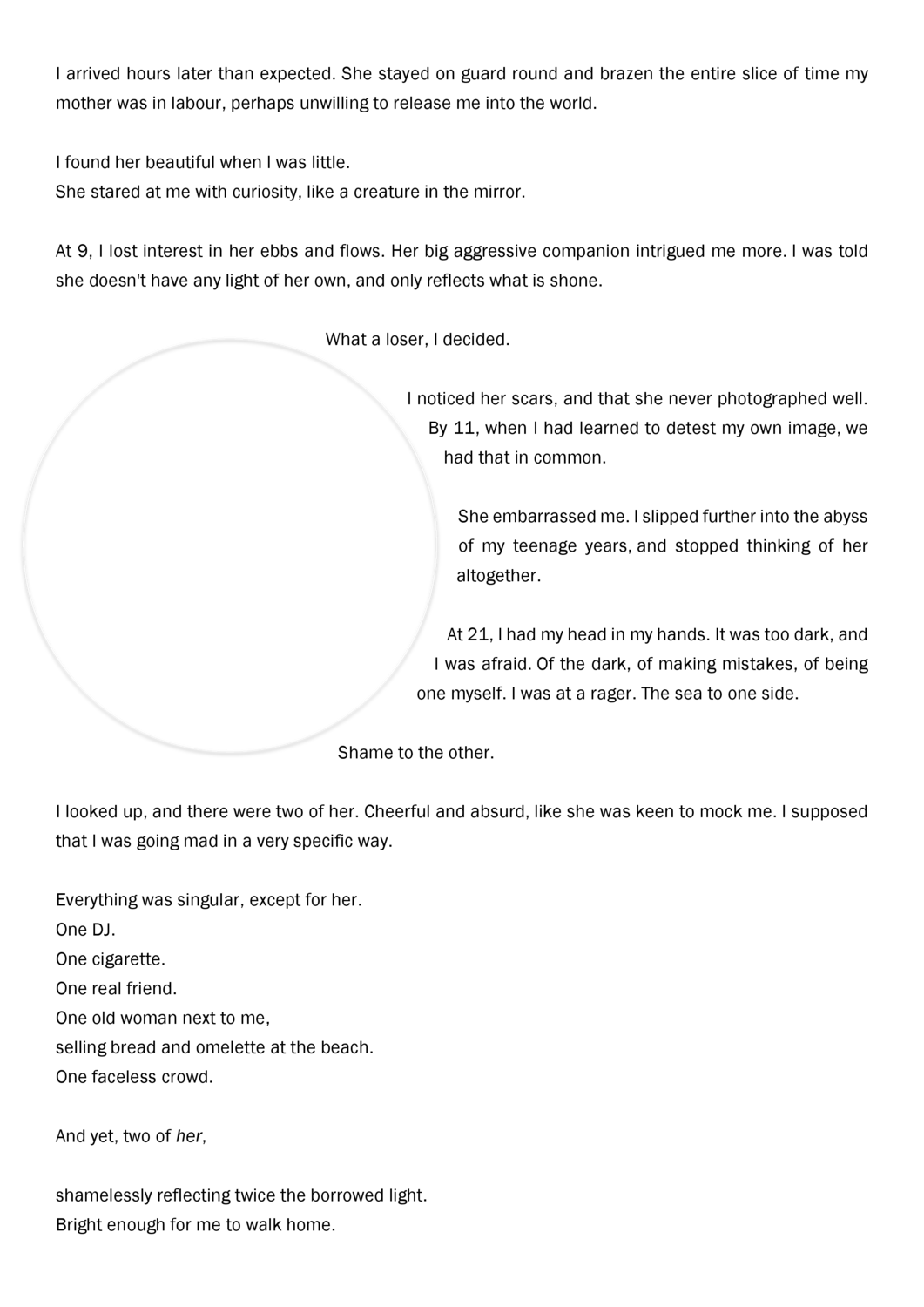
Luna by Bina Emanvel (visual poem)
Moon Phase
by Gerard Sarnat
We have lunate bones
in our wrists, which, when broken,
form waning crescents.
Perpetual Miss Insomnia Pageant: (Some Recurring Phases of the Mind)
by Liz Duff Young
By moonlight insomniac fingernails tattoo a violent haiku on pale thighs while reflections of stars
glitter in pooled syllables of dark blood.
(A preference for crescent moons, whether waxing or waning, because who
knows if gibbous moons are pronounced with a hard or a soft g.)
Light pouring into my room from a moon that’s either half full or half empty allows me to clearly
distinguish the phosphorescent pages of my book and vaguely intuit the dark words. This is not a
problem as night is more a mood than a plot.
Synapses like squashed lightning bugs
Moonless night of the sleepless mind
Melted wax scents the dark. Can you remember candles, matches, flame?
Like a sash on a beauty contestant’s swimsuit
Stripe of moonlight on ceiling
Miss Insomnia 2025
Miss Congeniality at home alone the night after the beauty pageant, fashioning her satin sash into a
garrote to strangle her lovely peers. Still in her swimsuit and high heels. Despite the manic gleam in
her eyes, her smile is as open and cheerful as usual, but is eclipsed by a lipstick smear on her teeth.
This makes me want to pull up a chair, lean forward, and offer her the fragile nape of my neck like a
consolation prize.
Close the curtains.
Don’t observe:
moon, stars, rain, snow, clouds
street lights, planes, birds, mosquitoes
their (oh so) ephemeral distractions
Try to dream of them instead.
(Mind flits through a brief semblance of pre-dawn sleep)
Then later a haze-clotted half-moon
sidles delinquent through late afternoon
believing itself fully incognito
while night and stars are somewhere else
avoiding this wan interim.
Loitering beneath a floppy hat large enough to cover my rhinestone tiara, wearing a loose dress over
my sequined swimsuit and sash, I yawn regally and endure the day, waiting for the coming night.
When I’ll win the pageant again.
Part V

No 44 - March 8, 2026, from the ongoing series: Moongrams by Nechama Winston (silver gelatin paper exposed to moonlight, Unique, 10h x 8w in.)
me, the medium, the message
by debanjana
last night,
i wrapped sadness—
a message in a glass bottle,
corked
depths
of madness,
an insipid spectacle.
i moved with the
shifting
land,
swam through
the
quicksand,
last night—
i became waves
for the moon to push and pull.
PARIS MOON
by Cristina A. Bejan
I never thought I would see the sky again.
Blue sky. Overcast sky. Bright sun. Rain.
Lightning. Pink sky. Purple sky.
Sunrise.Sunset.
Locked inside with no light from the outside
Only constant Fluorescentlight and absolutely
Nothing emanating, pulsing, shining from within
Institutions not just suppress light
They kill it.
But I would not / could not and ultimately did not
Let them kill mine – my own Cristina light.
Breaking free with only the help of an angel
Who could tell I was smart enough
To figure out my way on the outside
Walking through the final security door
I was blinded by the sky
That was North Carolina and then
8 years passed and I broke free again –
I am a woman who likes to take walks.
Moving from Colorado to France
What hit me first, the most, was the night sky
In USA it is not safe to walk after dark
But in Paris every evening when I stroll
I am greeted, comforted, accompanied by the
Loving half-smile of the moon.
Chassez la lune, elle revient au galop
by Emily Monaco
I take a walk around the block on Monday night;
I have a bone to pick with the moon.
For such a long time, she’s held something that’s mine,
something I’m ready to have for my own.
But she’s tricky, that moon, hiding behind some zinc roof, or lurking,
perhaps, in the murk of Saint Martin’s Canal.
I search for her near Gare de l’Est, wind warm, night fresh,
and the city comes alive with memories it has no right to.
Phone clutched in one hand, heavy brass keys in the other,
all that’s missing are the cigarettes I don’t smoke anymore,
stuffed down the front of this same dress.
(I put many things in boxes, but I throw nothing away.)
Cigarettes, then, and a village nearly a country away.
A test, I wonder? But then again, I’m not sad. I’m not anything.
Where is she, that moon? Will she succeed in eluding me yet again,
leaving me to abandon my hunt, still parched?
I seek the “well, at least” and drink, instead, the city:
the buses I never ride, not anymore, their empty seats bathed in buttery light;
the windows into other people’s normal
like ochre eyes in faces of calcaire.
I linger before the fence dividing sidewalk from tracks,
and through the grate, I glimpse a running girl, a nightmare I know.
But shemakes it – only just –and something catches in my chest.
Is this her gift, I wonder, as I scale the steps behind the gare:
for the city to become once more that inexhaustible,
lazily tappable
mine?
Is this my consolation prize, a distraction to keep me from asking
for the thing I entrusted to her for safekeeping,
on a night just like this so many years ago?
My foot lands on the top step. My head turns.
And all at once, there she is, the color of the oranges that saved me that year,
the ones I accumulated by the juicy, sweet dozen, so many I feared they’d rot.
So, this thing of mine,
the one I asked the moon to hold.
It’s got hard edges that poke when you least expect it,
and yet
it’s boundless, expanding me without warning beyond the confines of myself.
It hurts.
Or it used to.
I can’t remember.
I can almost remember.
A stranger is balancing his phone on the ledge. He means to photograph her.
We share a laugh, the moon and I.
Silly man. You cannot photograph the moon.
But you can stare. I stare.
(She doesn’t mind. She’s used to it.)
And after a time, when I’m convinced I won’t cry,
I ask.
And I wait.
And I wait.
A Starling Dance, For The Moon
by Grace Kilborne
All of mankind seems to revere me so.
To them, I’m bathed in glowing, godly light,
A cosmic soul consoling mortal hearts —
Oh, how I wish that was my honest truth.
Up here, the stars are caskets from my past,
I speak to them as if they’re still alive,
The silence stings, their burning light a grief —
You all look up at me, but do not see.
If I could visit Earth for just a day,
I’d watch my starlings dance against the dusk,
Entwined, enraptured by ancient movement —
My dear old friends migrated to the sky.
For now, I watch them from my fated cell,
Knowing my place in the great web of things.
If being here means they continue life,
I’ll stay, despite this curse, and dance alone.
PhD Defence
by Jon Baird
Esteemed colleagues,
My thesis is on the Moon:
On the orbit it takes eying humanity through the lens of cosmic eternality.
My thesis, to derive the gravitational constant using a focused laser in to-
-I missed a factor
Shit.
(Now I must remember Einstein like I remember Kesha…
Like my transformation to recognized depends on it.
And it does)
The moon has mass
Distorting contours of isogravitation
Represented here by a brace of letters
This one is time-
-It needs seconds to transgress the material world.
Done. The Moon will be pleased!
This one experiment, buried in the back, came to a number not entirely wrong (they are shocked)
And all of this, four years and counting, precipitates a constant:
The letter “G”, which I have, here, morphed to a badge of discovered knowledge
Delivered to history by way of pre-print (a data lake of memoirs) where I kiss the Moon
And move on
Biographies
-
Amanda Michaela (she/her) is a Texas-born, Paris-based poet. She holds a Master's in Human Rights and Humanitarian Action from Sciences Po Paris, and works at the intersection of legal advocacy, project design and social and migration policy.
-
Ana Flavia Lessa is a 27-year-old Brazilian chemical engineer who spent five years in Paris, until she began following a hidden poetic thread left behind by her father and, almost imperceptibly, drifted toward philosophy and language, coming to see nature as the most profound thinker and artist of all, recently becoming a farmer near the mountains.
-
Bina Emanvel is a writer, artist and activist. She has loved and lived in incredible cities - New Delhi, Berlin, New York, Dhaka, Abuja, Mexico City, and now Paris. Bina nurtured her first creative home in the brilliant and generous CDMX Writers Group, and is currently experimenting on Substack @binaemanvel
-
Charisse Gendron is a poet living in Portland, Maine, where she is a volunteer librarian and senior college teacher. Her work has appeared or is forthcoming in Anomaly Poetry, Blood & Bourbon, Empyrean, Feral, Halfway Down the Stairs, Prosetrics, Sabr Tooth Tiger, The RavensPerch, The Soliloquist, Trashlight, and other publications.
-
Christian Hanz Lozada (he/him) wrote the poetry book He's a Color Until He's Not, and his Pushcart and Best of the Net nominated poetry have been published in over 60 books, journals, and anthologies. He lives in San Pedro, CA and uses his MFA to teach his neighbors and their kids at L.A. Harbor College.
-
Born in Hong Kong and raised in Manila and San Francisco, I hold a PhD in creative writing from Lancaster University. My work appears in various publications, including Magma, Poetry Daily, Poetry Ireland Review, Poet Lore, and The Interpreter's House. My first full length collection, Women Twice Reviewed, was published in 2024 by Sixteen Rivers Press.
-
Christine is a Paris-based, self-taught collage artist and death doula exploring the integration of everyday eros with grief and transformation. Her work layers color and texture to evoke tension, paradox, and whimsy within the liminal space.
-
Cristina A. Bejan, DPhil (Oxon) is a Romanian and American award-winning author and artist living in Paris. She has published books in various genres: history, poetry and plays. A spoken word poet, her stage name is Lady Godiva: performing in DC, NC, NYC, LA, Colorado, Bucharest and the City of Light.
-
I was born in West Bromwich but grew up in North Lincolnshire. I was awarded a New Poets Bursary by the Northern Writers’ Awards, 2013 . My debut pamphlet is published by Wild Pressed. I have completed a sequence called Death and Taxis, which I’d like to include in another pamphlet.
-
debanjana is a queer multilingual designer based in paris. she occasionally masquerades as a poet or an artist, but always remains a student of life in pursuit of surprise.
-
While it was a pleasure to leave Swindon, Eira Twire continues to look wistfully back. In Paris, they studied Wiltshire folklore and their most recent novella is an absurd tale in a nowhere Wiltshire village. The draw of home is prevalent in their works owing to, they believe, a complicated Anglo-Indian, Welsh, and moonraking family history.
-
Emily Monaco is an American writer based in Paris for nearly 20 years. Her fiction is represented by the Heather Jackson Literary Agency in New York. She is currently seeking a home for her first novel, a love story about cheese.
-
Gerard Sarnat, MD is the author of HOMELESS CHRONICLES, Disputes, 17s, Melting Ice King. Gerry has been published by Rattle, Gargoyle, Newark Public Library, Blue Minaret, Columbia, Penn, Harvard, Brown, Yale, Pomona, Johns Hopkins, Stanford, Main-Street Rag, New Delta/ North Meridian/ Northampton/ Brooklyn/ LA/Buddhist Reviews, American Journal Poetry, Poetry Quarterly, SF Magazine, NY Times. gerardsarnat.com
-
Glen Vecchione has authored 28 science, math, and history titles that have been published worldwide. His poetry appears in Prairie Schooner, Penn Review, Missouri Review, and ZYZZYVA. His new work is forthcoming from Finishing Line Press and Rebel Satori. Glen divides his time between Palm Desert, California and Umbria, Italy.
-
Grace Kilborne is a Seattle-born writer who explores the interplay between humanity and nature. While pursuing a master's in Paris, PLU was the first open-mic night she attended, and is now the first magazine to publish her work! Other than writing, she enjoys outdoor adventures, making art, and good coffee.
-
Jean studied and worked in France and Spain, had a variety of jobs: bookseller at La Librarie Hachette in London, translator for SoFraMaC in Paris, taught at the British-American Institute in Madrid, worked as a film publicist and Stills librarian for Warner-Pathé, newspaper photographer and 25 years as an archivist. Her poems have appeared in several anthologies and publications.
-
Jon Baird is a former astrophysicist based in Paris with a PhD in gravitational waves. When not pondering the universe's more dramatic phenomena, he can be found with a glass of wine and a cat on his lap, wondering who has the best gluten free burger.
-
Kelly Pham was born in Vietnam and grew up in the United States. She has also lived in Japan and currently lives in the Paris region. She is an alternative perspective ambassador and hopes her writing will connect people through universal human experiences.
-
Based in Montreuil, Liz Duff Young is a writer, translator, and dancer who relays narrative through words or movements, shape-shifting between languages as long-term expatriates do.
-
Mark McDonnell had careers in teaching, industry and psychotherapy in the UK, USA and Spain. He currently focuses on teaching English to refugees, writing and singing. He has had work published in a range of journals in the UK, Ireland and Spain.
-
Michael Alcée’s work has appeared in Aphor, Black Iris, Eunoia Review, and Lines + Stars, and is forthcoming in Inflectionist Review and Panorama, among others. In addition to being a poet, he is a psychologist and author of Therapeutic Improvisation (Norton, 2022) and The Upside of OCD (Rowman & Littlefield, 2024).
-
Nechama Winston is an interdisciplinary artist based in NYC. She is the co-founder of New Poetics Publishing and works at Asya Geisberg Gallery. Winston is interested in working with the procedures of photography and film as a means to investigate social politics, history, and narrative, while working with the dark as a material and concept.
-
Paul Hostovsky's poems and essays appear widely online and in print. He has won a Pushcart Prize, two Best of the Net Awards, the FutureCycle Poetry Book Prize, and has been featured on Poetry Daily, Verse Daily, Only Poems, and The Writer's Almanac. He makes his living in Boston as a sign language interpreter and Braille instructor. www.paulhostovsky.com
-
Paul Stephenson’s debut collection Hard Drive was published by Carcanet in 2023 and was shortlisted for the Lambda Literary Award and the Polari Book Prize. He has three pamphlets including The Days That Followed Paris, written after the 2015 terrorist attacks. He co-edited the “Europe” (70) and recent “Ownership” (92) issues of Magma.
-
Sambhu Ramachandran is a bilingual poet from Kerala, India. He writes by night and spends his daylight hours as an Assistant Professor of English at N.S.S. College, Pandalam. His work has appeared in Another Chicago Magazine, Two Thirds North, The Bombay Literary Magazine, and The Tiger Moth Review, among many others.
-
Sarah James/Leavesley is a prize-winning poet, fiction writer, journalist and photographer. Darling Blue (Indigo Dreams, 2025) interweaves art-inspired poems with a book-length fictional poetry narrative of love, lust and letting go, while her collection The Magnetic Diaries (KFS, 2015) re-envisages Gustave Flaubert’s Madame Bovary in a contemporary English setting. www.sarah-james.co.uk.
-
Sue Burge is a writer, mentor and editor based in Norfolk, UK. Her pamphlets are Lumière and The Saltwater Diaries. She has three poetry collections with Live Canon: In the Kingdom of Shadows, Confetti Dancers and The Artificial Parisienne. Her latest collection watch it slowly fade was published in 2025. www.sueburge.co.uk